Effective: 1 October 2026
FTA-published English document, labelled unofficial translation. Original supplied PDF, 4 pages.
Download original PDFIssued on 9 September 2026 and effective from 1 October 2026, FTA Decision No. 17 of 2026 specifies cases and conditions for recovering input tax on goods or services provided to employees free of charge. It applies where there is a contractual obligation or documented policy under Article 53(1)(c)(2) of the VAT Executive Regulation. Each expense category has its own requirements, all of which must be met.
Source documents & MJS briefing
FTA publication: Decision No. 17 of 2026This MJS summary is for general information. Recovery is conditional, not automatic. Refer to the complete legislation and the source document for interpretation and application.
View MJS briefing graphics (1)
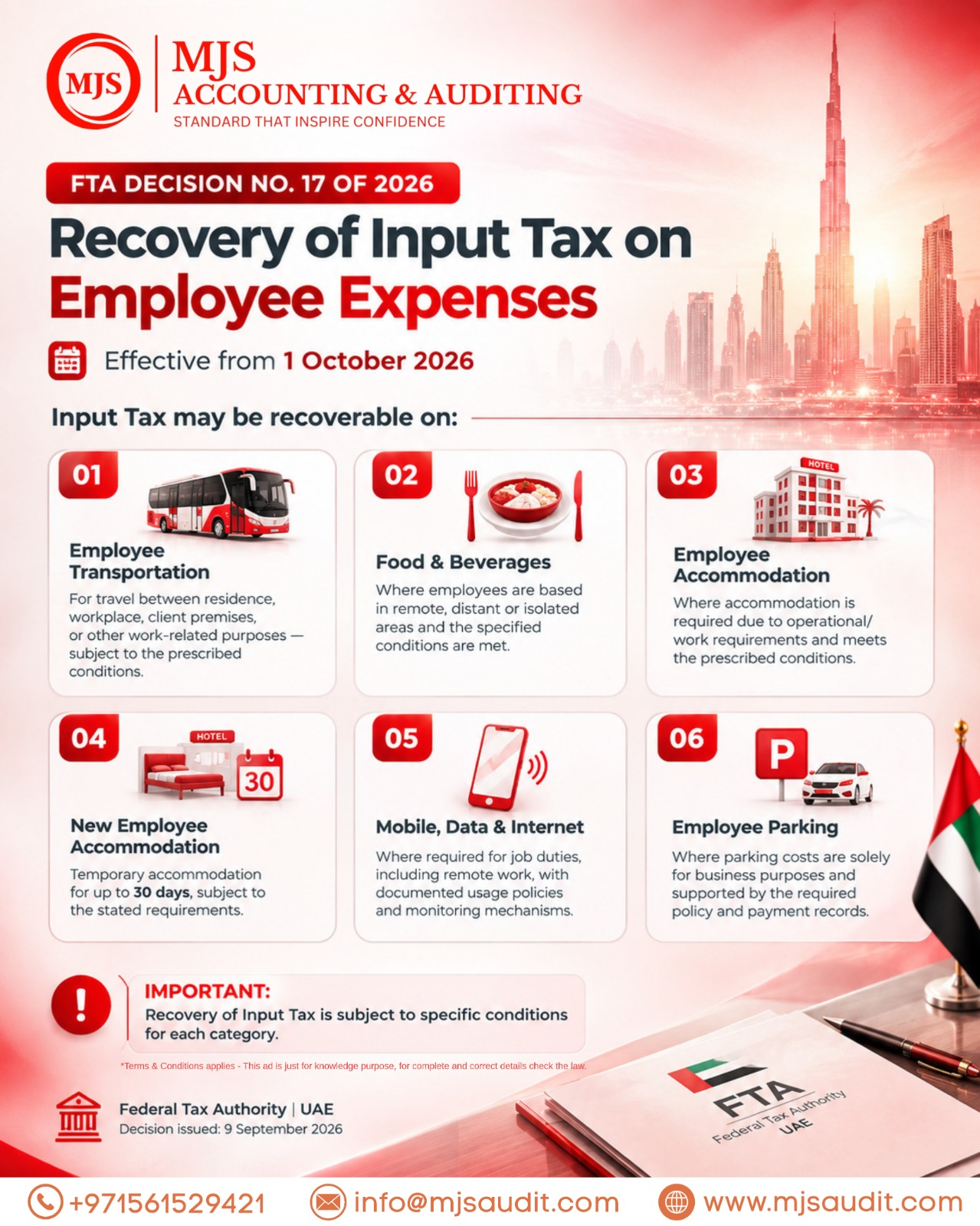
1. Employee transportation
Input tax on transportation expenses may be recovered where all three conditions apply:
- Transport is only between the employee’s residence and workplace, to clients’ premises, or for another purpose directly related to job duties.
- The service is not used for the employee’s personal benefit.
- The employee cannot choose a cash allowance or financial compensation instead of the transport service.
2. Food and beverages
This category concerns employees living in remote, distant or isolated areas. All of the following are required:
- The employee’s residence is in a remote, distant or isolated area.
- Suitable food preparation services or facilities are unavailable at the residence or workplace, as applicable, and there are no nearby restaurants or facilities where food and beverages can easily be obtained.
- The provision is directly connected to the work period or the residence period required by the job.
- The employee cannot choose a cash allowance instead of the food and beverages.
3. Accommodation required for work
Accommodation must meet operational needs rather than form part of ordinary employee benefits or compensation. All of these conditions apply:
- The employee cannot choose cash or financial compensation instead of accommodation.
- The accommodation is linked to operational requirements and is not part of ordinary benefits or compensation arrangements.
- The work requires the employee to live near the workplace, work site or client’s location.
- It is exclusively for the relevant employee, without family residence or other personal use, except where permanent residence near the workplace is required and it becomes the employee’s usual residence.
- The accommodation and its fittings are proportionate to job requirements and basic residential needs, without significant recreational or personal features beyond the work purpose.
4. Temporary accommodation for new employees
The decision separately covers accommodation for new employees where both conditions are satisfied:
- The accommodation is temporary and provided for no longer than 30 days.
- It is proportionate to the job requirements and basic residential needs.
5. Mobile phones, airtime, data and home internet
Phones, airtime, data packages and home internet through a modem or router may qualify where all of the following apply:
- They are necessary for job duties, including work outside normal hours, remote work or work-related communications.
- Use is for work, with any personal use incidental and insignificant rather than the main purpose.
- A documented internal policy defines permitted use and the consequences of unauthorised use.
- Reasonable monitoring verifies compliance, and relevant records and justifications for unauthorised use are retained.
6. Employee parking
Input tax on fees for parking spaces allocated to employees may be recovered where all three conditions are met:
- The fees are solely for business purposes and directly connected to job duties, business visits or related assignments.
- A documented internal policy specifies when parking fees may be reimbursed and the applicable approval process.
- Payment evidence is retained, such as receipts showing the date, time, fee amount and tax paid.
How this relates to Cabinet Decision No. 149 of 2026
Cabinet Decision No. 149 of 2026 amended the employee-benefit provisions in Article 53. Decision No. 17 supplies the specific cases and conditions for the contractual-obligation or documented-policy route. A policy alone does not establish recovery: the applicable category requirements must also be satisfied.
Official Regulatory References & Citations:
Have questions regarding this regulation?
Connect directly with MJS Accounting & Auditing experts via WhatsApp or schedule an office consultation.